There are moments in television that stay with audiences long after the cameras stop rolling. Sometimes, they happen when a famous performer delivers an unforgettable performance. Other times, they begin with someone almost nobody expects to become a star. For Susan Boyle, the defining moment of her life arrived on the stage of Britain’s Got Talent in April 2009, when she performed “I Dreamed a Dream” from Les Misérables.
At first, the Scottish singer appeared to be an ordinary contestant with an extraordinary ambition. Her relaxed manner, straightforward personality, and confident declaration that she wanted to become a professional singer prompted skepticism from some people in the room. But when she began to sing, the atmosphere changed. Her rich, expressive voice revealed a level of musical ability that many had not anticipated.
Britain’s Got Talent
+1
What followed became one of the most memorable auditions in modern talent-show history. Susan Boyle reminded viewers that a person’s appearance, age, or background cannot tell the whole story of their abilities. Her performance was not simply about hitting the right notes. It was about opportunity, perseverance, and the courage to pursue a dream even when success seems uncertain.
More than a competition audition, it was the beginning of a remarkable public journey.
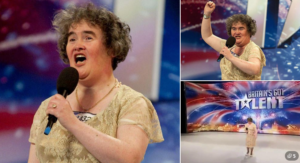
🎤✨ An Unexpected Voice, an Unforgettable Dream 🌟
1. Susan Boyle’s Background: A Dream Years in the Making
Before her appearance on Britain’s Got Talent, Susan Boyle was not an internationally recognized recording artist. She was a Scottish woman with a longstanding love of singing who had yet to receive the kind of opportunity that could transform her passion into a professional career.
Born in West Lothian, Scotland, Boyle had been involved in singing from a young age. She participated in church singing and continued developing her interest in music over the years. Although performing was important to her, she had not established herself as a major recording artist before the television audition that introduced her to a global audience.
ABC News
+1
That background matters because the audition did not emerge from nowhere. Boyle’s performance represented the culmination of an interest that had been part of her life for decades. She was not someone who had suddenly discovered a talent backstage. Rather, she was someone whose ability had not yet reached a wide audience.
In interviews following her breakthrough, Boyle explained that her decision to apply for the show was connected to a promise she had made to her late mother. She wanted to do something meaningful with her life, and entering the competition became a way of acting on that commitment.
News24
+1
This personal motivation adds another dimension to the story. Her audition was an opportunity to test herself, but it also carried emotional significance beyond the competition itself.
When Boyle walked onto the stage, she was 47 years old and approaching her 48th birthday. At a time when many entertainment-industry opportunities appear focused on youth, she represented a different kind of contestant: an adult pursuing a long-held ambition rather than a teenager hoping to launch a career.
She also possessed a personality that came across as direct, humorous, and unpretentious. She did not attempt to manufacture a glamorous celebrity image before she had even sung a note.
That combination of life experience, personal determination, and genuine enthusiasm made her appearance distinctive. Yet the most important part of her story was still waiting to unfold.
The audience had heard about her ambition. The judges had met the contestant. Now it was time for them to hear the singer.
2. The Moment That Changed Everything: “I Dreamed a Dream”
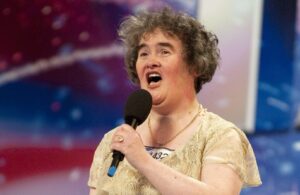
The audition took place in Glasgow during the 2009 series of Britain’s Got Talent. Boyle stepped forward to introduce herself to the judging panel, which included Simon Cowell, Amanda Holden, and Piers Morgan. The exchange before her performance established the contrast that would become central to the audition’s impact.
The Guardian
+1
Boyle spoke openly about her ambition to become a professional singer like Elaine Paige, the acclaimed British musical-theater performer. Her answer communicated a clear goal, but the reaction around her was not immediately one of enthusiastic confidence.
The audience’s initial response included laughter and skepticism. Some people appeared to form expectations before hearing her sing. That reaction would soon become an important part of the audition’s story—not because it defined Boyle, but because the performance challenged it.
Then came the opening of “I Dreamed a Dream,” the emotional ballad from Les Misérables.
The change was striking.
Boyle’s voice carried a depth and expressive quality that immediately shifted attention away from the pre-performance conversation. Instead of the tentative singer some spectators may have anticipated, they heard a performer capable of delivering a demanding musical-theater song with conviction.
The song itself was an especially fitting choice. Its themes of lost hopes, difficult experiences, and dreams that endure despite disappointment gave Boyle’s performance an emotional framework that audiences could understand. She did not need to explain her entire life story before singing. The music provided its own dramatic setting.
As the performance continued, the judges’ reactions changed. The skeptical atmosphere gave way to visible surprise and appreciation, while the audience responded with growing enthusiasm. Contemporary reporting described the audition ending in a standing ovation.
The Guardian
+1
That progression is what makes the clip so compelling. The performance did not begin with everyone already convinced that they were witnessing a star. Viewers watched expectations change in real time.
By the final notes, Boyle had demonstrated that her voice deserved to be heard on its own merits. Her audition had become more than a successful attempt to advance in a competition. It had become a defining moment in her life.
And for the millions of people who would discover the performance online, the most memorable part was not the skepticism at the beginning. It was the transformation that took place once she started singing.
3. The Emotional Highlights: More Than a Surprise

One of the most powerful elements of Susan Boyle’s audition is the contrast between what happens before the music begins and what happens after it starts.
Television talent competitions often introduce contestants through short conversations that help audiences form an impression of the person who is about to perform. In Boyle’s case, her appearance, age, and straightforward manner became part of the setup. The audience could see her before it knew what she could do.
That sequence created an uncomfortable but revealing tension. People were reacting to the person in front of them before they had heard the talent she was bringing to the stage.
When Boyle began singing, those early assumptions became much less relevant.
Her vocal performance supplied the evidence that mattered. The richness of her voice, the emotional character of the song, and her ability to sustain the performance gave the judges and audience a reason to reconsider their expectations. It was a reminder that talent cannot always be predicted from a first impression.
Another emotional highlight is the song itself. “I Dreamed a Dream” is associated with longing, disappointment, and the distance between youthful hopes and adult experience. Boyle’s life experience gave her interpretation an added resonance for listeners, although it would be unfair to assume that every emotion in the song directly reflected a specific event in her personal life.
The connection emerges from the combination of the music and the moment. An older contestant was standing in front of a national television audience, pursuing a professional opportunity that had remained out of reach for much of her life.
There is also something moving about the simplicity of her ambition. Boyle did not enter the stage claiming to be a celebrity or promising to revolutionize the music industry. She wanted to sing professionally. That was the dream she put forward, and the performance allowed the audience to hear why it mattered.
The judges’ changing expressions and the audience’s enthusiastic response made the emotional progression visible. Viewers were not simply hearing a song; they were witnessing a person’s ability become impossible to overlook.
Ultimately, the audition’s emotional power comes from that combination of musical excellence and human vulnerability. Boyle had taken a risk by putting herself in front of strangers who would decide whether she could progress. The result was a performance that invited audiences to reconsider not only her, but also the assumptions people make about others.
4. The Judges’ Reactions and the Details That Made the Audition Memorable
The judging panel played an important role in shaping the audition’s impact. Simon Cowell, Amanda Holden, and Piers Morgan were evaluating contestants for a competitive television program, but their reactions also helped viewers understand the significance of what they had just witnessed.
Before Boyle sang, her declaration that she hoped to become a professional singer like Elaine Paige drew a skeptical response from parts of the audience. It was a bold ambition, particularly for someone who had not yet established a professional singing career.
The performance changed the tone of the room.
Contemporary coverage described the judges as visibly impressed and the audience as rising to its feet. The change was especially striking because the audition had begun with uncertainty about Boyle’s prospects.
The Guardian
+1
That reversal became a central part of the way the performance was discussed in the days that followed. The story was easy to understand even for people who had never watched Britain’s Got Talent: a contestant walked onstage, faced doubts, sang exceptionally well, and changed the room’s reaction.
It also made the audition unusually effective as television storytelling. The introduction established expectations, the song challenged them, and the audience response delivered a satisfying emotional conclusion.
The video subsequently spread rapidly online. News coverage in April 2009 documented the extraordinary attention surrounding Boyle’s performance, with viewers sharing the clip and discussing the singer across the internet.
CBS News
+1
That online response mattered because it took the audition beyond the original broadcast. People who had never watched the program could encounter Boyle’s performance independently. The clip did not require a detailed understanding of the competition or its previous contestants. Its central story was immediately accessible.
It is also important to distinguish the audition from what happened later. Boyle’s first appearance introduced her to a mass audience, but it was not the final result of the competition. She continued through the series and eventually finished as runner-up to dance group Diversity. Her subsequent career developed beyond the show itself.
Ticketmaster UK
+1
Those details help explain why the original performance remains significant. It was the starting point of a professional transformation, not an isolated television moment with no lasting consequences.
The judges’ surprise was memorable, but Boyle’s voice was the reason the moment endured.
5. Why Susan Boyle’s Audition Still Connects With Viewers
Some performances impress people because of technical skill. Others become memorable because they tell a story that audiences recognize in their own lives. Susan Boyle’s audition achieved both.
At its heart, the performance is about the gap between having a dream and finding an opportunity to pursue it. Boyle had a clear ambition, but she had not yet found the platform that could bring her talent to a large audience. Britain’s Got Talent provided that platform, and her audition demonstrated what could happen when an overlooked ability finally received attention.
The story also challenges the habit of judging people too quickly. Before Boyle sang, the audience had already begun forming opinions about her. The performance exposed the limitations of those first impressions. Her appearance had offered no reliable indication of the power of her voice.
That message remains relevant well beyond entertainment. People often underestimate others because of their age, appearance, background, or circumstances. Boyle’s audition offers a memorable reminder that these characteristics do not determine a person’s abilities or potential.
Her age also helped distinguish her story from the familiar narrative of a young performer searching for fame. At 47, she arrived with years of experience and a dream that had not disappeared simply because it had taken time to pursue.
The song contributed to the connection, too. Its themes of hope and disappointment gave the performance an emotional depth that extended beyond the competition’s immediate stakes.
Finally, the audition invites viewers to experience the pleasure of being surprised. The most satisfying moments are sometimes those that force us to revise an assumption and recognize something wonderful we had not expected.
Boyle did not need a complicated explanation to make her point. She stepped forward, sang, and let her ability speak for itself.
That is why the audition continues to offer something more substantial than a simple surprise. It is a story about being heard, taking a chance, and discovering that a dream can remain worth pursuing even after years of waiting.
6. From a Television Audition to an International Career
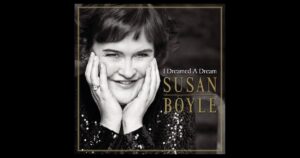
The original audition was only the beginning of Susan Boyle’s journey. The attention it generated quickly moved beyond the television competition, turning a previously little-known Scottish singer into an international entertainment story.
In the weeks following her appearance, news organizations reported on the enormous online interest in the performance. The clip’s spread demonstrated how internet video could introduce a performer to audiences around the world in a remarkably short period.
CBS News
+1
Boyle continued competing on Britain’s Got Talent, performing additional songs and progressing to the final. Although she did not win the competition, finishing second did not prevent her from building a successful recording career. Dance group Diversity took the title, while Boyle emerged as one of the show’s most recognizable performers.
Ticketmaster UK
+1
Her debut album, I Dreamed a Dream, was released in 2009. Its title returned to the song that had introduced her to millions of viewers and connected her new professional identity to the audition that started everything.
The album’s success established that public interest in Boyle was not limited to curiosity about a television moment. Audiences were interested in hearing more of her music. Her career continued with further albums, live performances, and television appearances.
Singers
+1
Looking back, it is tempting to treat the audition as if its outcome had always been inevitable. But that interpretation overlooks the uncertainty involved in taking the stage. Boyle entered the competition without knowing how the judges would respond or how many people would eventually watch her performance.
What made the moment consequential was the combination of preparation, opportunity, and an ability that audiences could hear for themselves.
Her story also demonstrates that success does not always follow a conventional timeline. A professional breakthrough can arrive later than expected, and an important opportunity can emerge from a place that initially seems ordinary.
The original audition remains the clearest introduction to that journey. Before the albums, the international attention, and the subsequent performances, there was a contestant with a dream and a song she wanted the world to hear.
7. Conclusion: The Power of Being Given a Chance
Susan Boyle’s first Britain’s Got Talent audition remains memorable because it brought together an extraordinary voice, an emotionally resonant song, and a moment that challenged expectations.
When Boyle walked onto the stage in 2009, she was a 47-year-old Scottish singer hoping to become a professional performer. Her ambition was clear, but the reaction before she sang showed how quickly people can form judgments without knowing what someone is capable of doing.
Then she began “I Dreamed a Dream.”
The richness of her voice transformed the atmosphere, and the judges’ surprise and the audience’s enthusiastic response turned the audition into a defining television moment. The performance subsequently reached audiences around the world, helping launch a recording career that extended far beyond the competition.
Britain’s Got Talent
+1
Yet the lasting appeal of the audition goes beyond its outcome. It reminds viewers that talent can exist outside familiar expectations, that pursuing a dream does not have to follow a particular timetable, and that sometimes the most important thing a person needs is an opportunity to demonstrate what they can do.
That message is just as meaningful today as it was when the performance first aired.
If you have not watched the audition recently, take a few minutes to revisit the original video below. Listen to the performance, watch how the atmosphere changes, and consider which moment stays with you most.
What do you find most inspiring about Susan Boyle’s audition: her voice, her determination, or the way she challenged the audience’s expectations? Share your thoughts in the comments.