Maarty Broekman’s Keytar Audition Turns Britain’s Got Talent Into an ’80s Time Machine

Britain’s Got Talent has welcomed countless singers and musicians, but Maarty Broekman arrived with an instrument and personality rarely seen on the competition’s stage.
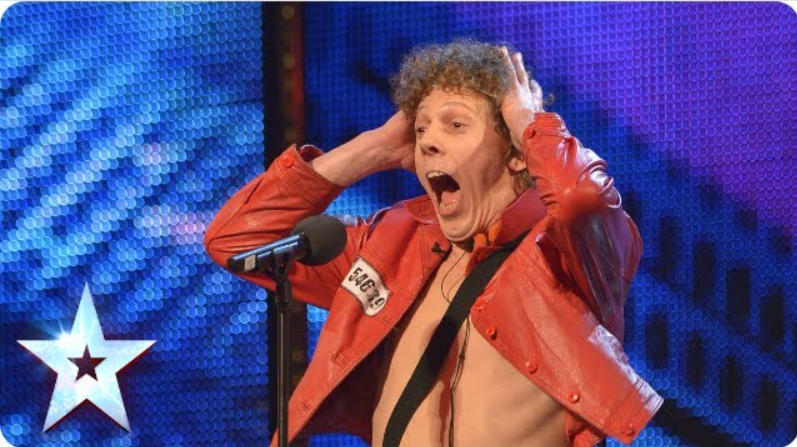
During his 2013 audition, Maarty appeared carrying a keytar and announced his mission to revive the music, fashion and energy of the 1980s. The official Britain’s Got Talent video presents the performance as his attempt to impress judge Alesha Dixon with his retro electronic style.
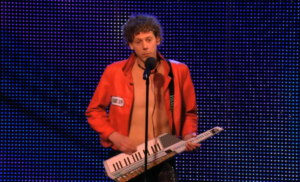
Instead of selecting a modern chart hit or performing a traditional ballad, Maarty created a colorful Euro-pop performance built around synthesizer sounds, theatrical confidence and playful interaction with the judges.
A Keytar Player With a Clear Musical Identity
A keytar combines the keys of an electronic keyboard with the portable shape and stage freedom of a guitar. The instrument became strongly associated with synth-pop and electronic performers during the 1980s.
For Maarty, the keytar was not simply an unusual prop. It was the center of his entire performance identity.
His personal artist profile describes him as a Euro-pop musician from the Amsterdam area with a particular love for 1980s Euro-disco, vintage instruments and the visual culture surrounding that music.
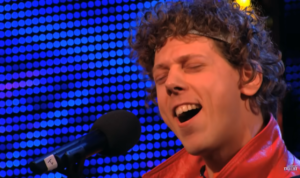
That passion was visible throughout his Britain’s Got Talent audition. His clothing, hairstyle, movements and electronic sound all worked together to create the impression of a performer who had stepped directly out of another decade.
Maarty Tried to Charm Alesha Dixon
The audition also included a playful romantic element.
Maarty directed much of his attention toward Alesha Dixon, using his performance and exaggerated confidence in an attempt to win her over. The official video description specifically identifies the act as Maarty trying to woo Alesha with his keytar.
The unusual combination of retro music and flirtatious comedy helped the performance feel different from an ordinary singing audition.
Some audience members responded enthusiastically to his energy, while the judges appeared divided over the musical quality of the act. Simon Cowell was noticeably less impressed than the rest of the panel, creating a humorous contrast with Maarty’s enormous confidence.
Three Judges Said Yes
Despite the mixed reaction, Maarty earned enough support to continue in the competition.
ITV confirmed that three judges voted yes after his first audition, while the remaining judge declined to send him forward.
The result demonstrated that a performer does not need unanimous approval to make a memorable impact. Maarty’s originality, personality and commitment to his retro concept were enough to secure his place in the next stage.
His performance also showed that talent competitions are not judged solely on vocal technique. Entertainment value, stage presence and the ability to give the audience something unexpected can be equally important.
From Audition to the Live Semi-Finals
Maarty’s Britain’s Got Talent journey continued beyond the audition stage.
He was selected as one of the acts appearing in the live semi-finals of Series 7. In his semi-final performance, Maarty continued his 1980s-inspired character and returned with another energetic keytar number. Britain’s Got Talent introduced him as a “born ’80s entertainer,” showing that his retro personality had become the defining feature of his act.
Maarty competed in the fifth semi-final but did not receive enough public support to reach the grand final. The official competition results list him as finishing sixth in that semi-final.
Although his competition ended before the final, reaching the live shows was still a significant achievement for such an unconventional performer.
Why Maarty’s Audition Remains Memorable
Maarty Broekman’s audition continues to entertain viewers because he appeared completely comfortable being different.
He did not attempt to copy a current pop star or change his musical identity to match modern trends. Instead, he walked onto one of Britain’s biggest television stages and confidently celebrated the music he loved.
His performance offered viewers a complete visual and musical concept rather than just a song. The keytar, colorful styling, electronic sound and exaggerated personality all belonged to the same retro world.
Even people who were not convinced by his singing could understand what made the act distinctive.
That clarity is often important on talent shows. Thousands of performers may possess strong voices, but fewer arrive with a character and style that audiences can recognize immediately.
Britain’s Got Talent Continued Featuring Him
Maarty remained connected with Britain’s Got Talent after his season.
The program released additional content featuring him, including a humorous video in which he taught viewers how to become an 1980s-style star.
He also appeared in Britain’s Got Talent-related content the following year, offering opinions about contestants and continuing to play the eccentric retro personality audiences remembered from his audition.
These appearances showed that Maarty had created a memorable television character even without reaching the final.
A Performer Who Refused to Follow Trends
Maarty Broekman may not have won Britain’s Got Talent, but his audition delivered something the show values highly: originality.
He walked onto the stage with a keytar, dressed like an electronic pop musician from the 1980s and attempted to charm Alesha Dixon with a performance unlike anything else in the episode.
Three judges supported him, the audience remembered him, and his act carried him all the way to the live semi-finals.
His audition remains a reminder that performers do not always need to follow current trends to find an audience. Sometimes, complete confidence in an unusual idea can be more memorable than technical perfection.
For a few minutes, Maarty turned Britain’s Got Talent into an electronic pop show from another decade—and proved that the keytar still had a place on a modern stage.